Saturday, 17 October 2015

Bryn Du

 I went for a afternoon walk over to  the gas tanks and was amazed  by how many Crossbills are about and so a flock of  about 60 and lots of smaller flocks and would say must be easy over a hundred crossbills in the forest and i found a  mixed flock   of finches and there were Goldfinch and siskin and about 50 in total and also had a female Brambling in the flock and first for  Autumm for me and great too hear the call again .In the Forest is a nice patch of limestone and found some Match Stick Lichen growing on it .Also growing all the the Road i found a nice patch of Earth Tongue and still give me a buzz too see it .


 Found Lots of these Gills and thought Brittle Gill after see them last week at Parc Slip and also super dog dropped in when i was there .

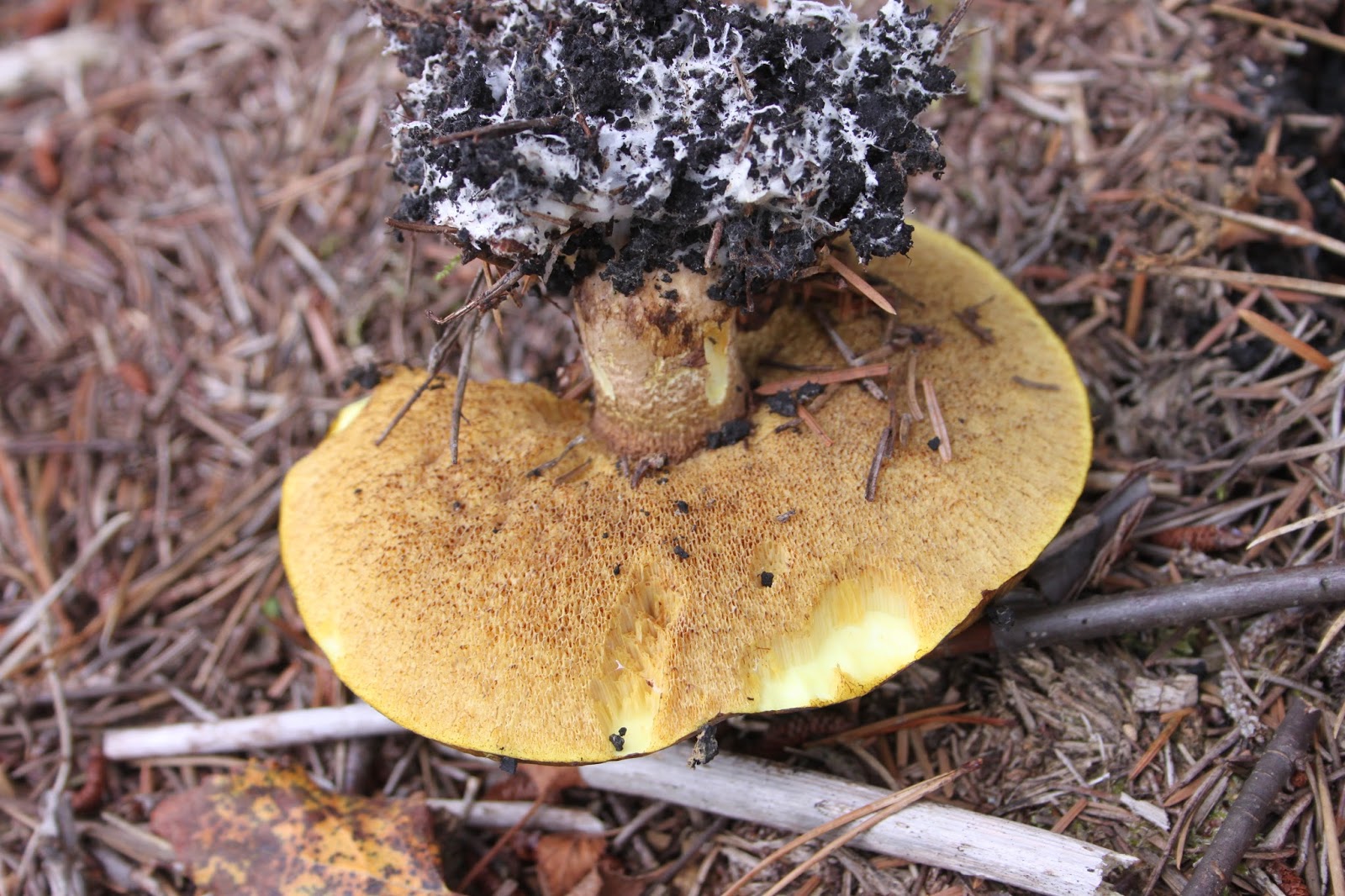
 Some kind of Boletus which could be Larch Bolets.

Thursday, 15 October 2015

Earth Tongues

Okay, so this is a pretty poor photo, but it shows some of the dozens of Earth Tongues I found emerging in a client's lawn today. Most were still, in these uncharacteristic shapes, probably because they were newly emerging, but some had the recognisable tongue shape. Either way, they are tough old things because I only noticed them after they had been run over by a heavy mower, with a rear roller, so they survived the blades and the roller, just springing back upright after, as if nothing had happened.
You haven't missed them, Martin. They are still about.


Wednesday, 14 October 2015

Dan y darren

I've been checking the scree slope and quarry for a week or so and this morning at least 2 birds were on site, tuck tucking, but almost impossible to see. On Monday I had my first redwing with c35 birds briefly feeding on hawthorn before moving south. Strangest recent obs was a kingfisher feeding on stream adjacent to the west cattle grid on Cwm Cadlan on the 08/10/15. Flushed from south side of road it flew upstream to area of whats left of Welsh Water compound before flying fast and low west.

Tuesday, 13 October 2015

Cobalt Crust

 After Feeling like I was the only Person who had not seen this cracking Fungus and my lucky  had too changed and Mark told me last year he had found some in Abernant and i looked for it and could not find it . So i thought i would look again and the sunlight hit  the fungus and i could  see it on the underside of what looks like an Hawthorn branch and how can something so colourful be so hard too see and it was great too see and i got too find my own now and Thank you Mark for tell me where it was and information Brilliant has always. .


 I found this on a Birch log and thought first it was pips or bird pooo and on looking close could see it was a fungus and learned it,s called Purple Jelly Disc and new too me.
 It,s alway nice too see frogs and this little chap put up a good show,
It feels like everywhere i go lately i find Elephant Hawkmoths Caterpillar and they same too be getting in smaller .
 I found this fungus on a fallen larch tree and looks like Yellow Brain Fungus , But never seen it on Larch before .Last  one Sunset sunday night and alway great too see.

Sunday, 11 October 2015

Quality Time

Having been forced to abandon two attempted raven counts this month, due to fog, I was really hoping for third time lucky this morning. As it happens, the weather played ball and the count went ahead with no problems. A respectable (for October) total of 162 was the result and although I haven't seen any yet, I heard my first Redwings of the season, calling overhead in the darkness before the count started.

I wondered what to do and where to go next and on a whim, decided to visit Llyn Fach, which as well as being a SSSI, is in the process of becoming a Wildlife Trust managed reserve. Parking at the entrance to the forest access road, just above Tower colliery, it took me over an hour to walk/bird my way to the this beautiful, natural glacial lake, noting amongst other things, four large Long-tailed Tit flocks along the way.

Once at the Llyn Fach, my main object was to search the screes and rock faces for clubmosses, so I began to ascend the S.Eastern side, following the well defined terminal moraine until it met the side of the cwm, then heading into the cwm, traversing the small open patches of scree and scrambling through the tall heather and whimberry.

Llyn Fach from the South


A sound like stones being tapped together, alerted me to the presence of a Ring Ouzel, which was perched in a low, bare Rowan. It called and twitched its tail and wings, obviously agitated by my presence , so I carried on my way, moving away from it and noting that there was another calling. I stopped to check on the original bird and it had left the tree to join another on the ground. One of them was definitely a male, but I was unable to work out whether the second one was a female of a Juv.
All the Rowans were bare, but the Whimberries were still laden with fruit and such fruit. I have never seen such huge Whimberries in all my days. Most were around 10mm in diameter, but some were as large as the commercial Blueberries one sees in the supermarkets. It was these I think the RZs were feeding on.

I carried on around the scree slope, heading for what seemed to be the most accessible section of rock face that side of the cwm, but it was more of a struggle to get to than I'd anticipated. On the way, I saw another Ring Ouzel, which was another male.

Finally getting to the rock, I was immediately surprised and delighted to see a Harebell still in full bloom. There were plenty of others there that had gone over and had only seed pods, but this plant was still looking beautiful.

Harebells (Mr Bell might know them as Bluebells)


Just after noting the Harebell and only a few metres away, I found my target species; Fir Clubmoss. Later I was to see lots more of it, but this was the only accessible plant of it I saw.

Fir Clubmoss


I was getting excited by the site and wondered what it might turn up next. I decided to look for Filmy Ferns, which although I've never seen them there, are to be found in Dare Valley country park. I explored the damper parts of the rock, where a constant drip occurs and under a wet overhang, deep in shade, I came across a colony of them, all hanging down from the roof. I am not familiar with the filmy ferns, having only seen one once, a long time ago, so I took lots of photos, hoping to be able to identify it at home. As hoped, I was indeed able to identify it as Wilson's Filmy Fern, which although far from common, is the commonest of the three filmy ferns and probably the one I saw all those years ago.

Wilson's Filmy Fern


At another section of rock, in a wet area at its base, I found some ferns I didn't recognise. They were obviously deciduous and in the process of dying back, so I took photos and collected a frond. Right next to them was a colony of Oak Fern and both growing as they do, on running rootstocks, the two ferns intermingled in places. At home, I identified it as Beech Fern (the names Oak and Beech are pretty meaningless, in the context of these ferns, as neither has any affiliation or association to its namesake). I now recall the Warden of the fledgeling reserve mentioning Beech Fern being present, so it was nice to actually see it.

Beech Fern


I had now run out of time and for some reason decided the only was was up, so noting the distant call of a fourth Ring Ouzel, I struggled long and hard, eventually, miraculously, reaching the top without either having a heart attack or having my knee caps pop out.
All in all, a pretty successful day.

Tir founder + colonists

Whilst Phil jets of to Peru, I make do with a stroll around Tir Founder before heading of coaching. The Cetti's Warb, found recently, was still belting out its song. Two Willow Tit were heard - and three similar looking birds flew out of the bush, but I couldn't get on to them to check if all three were Willow Tit.

After coaching I took a trip down to Port Enyon. The birding was quiet but a patch of Ivy was heaving with Ivy Colletes bees (Colletes hederae).


This bee was first identified by science as recently as 1993, from southern Europe, and it was first recorded in the UK in 2001. By 2009 it had colonised much of the English south coast, and now is well established in the Gower. It's more or less restricted to feeding on Ivy, so it's a late emerging species - on the wing from September through to November. At first glance it looks a bit like a Honey Bee - its about the same size - but the thorax is more golden coloured with neat pale bands at the edge of each abdominal segment.  A species worth keeping an eye out for.

Sunday, 4 October 2015

where are all the birds

A frustrating day with Martin and Phil. We decided to bird around the Aberthaw area - looking for any migrants about. Mist made viewing difficult early on, but a steady, if somewhat thin, passage of Swallows, Meadow Pipits, Skylarks, Linnets and Goldfinches was noted. But nothing out of the ordinary.

With the phone telling us the Cattle Egret was still at Kenfig, and a Yellow-browed had been found there earlier, we decided to nip over to the reserve. Bording was again quiet, though Martin and Phil did manage to get on to a late Garden Warb. A wander through the dunes failed to find any sheep, never mind the Cattle Egret.
The day was saved by a mixed party of small stuff, mainly Long-tailed Tits, that included a single Marsh Tit.

                                                    Great Green Bushcricket
                                                   Wooly Milkcup