I spend a pleasant morning in the company of Martin Bevan, as we did our BBS upland square. It felt really strange to be stripping off fleeces and birding in shirtsleeves on this early visit - I can only recall doing that once before, in the twenty-odd years we've been doing that square.
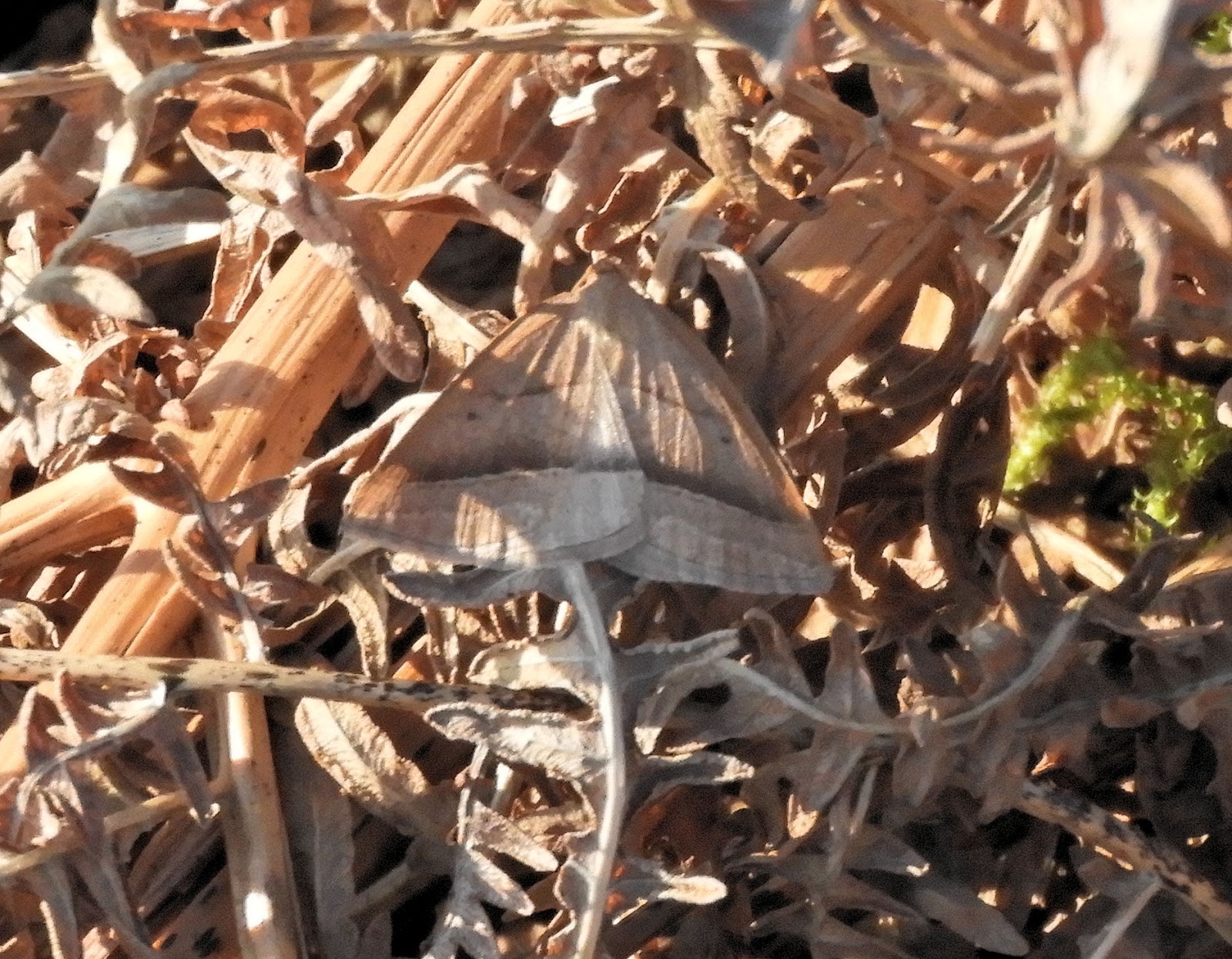
As it was so warm from the start, we saw a Speckled Wood on the first leg, which is unheard of and also, a Brown Silver-line moth.
I had my first Swallows of the year and also my first Redstart on that first transect.
We had more Stonechats than you could shake a stick at, but it was all at once, near the end that we had our best birds We saw a Male Cuckoo, pursued by a female, flying past a little way off but the best two birds I'll leave Martin to tell of, as it was he who found them.
From the top of Mynydd Merthyr, we could see a column of smoke from a mountain fire, somewhere over Maesteg way and at the top of it there appeared to be a Pyrocumulus cloud, though it wasn't typical, as it had been forced to spread out, due to the boundary of two thermal layers in the atmosphere.
On the way back down, we saw a Common Heat moth and four more species of butterfly; these being Orange Tip, Small White , Small Tortoiseshell and Peacock.
While concentrating on watching the Small white, as it flew past, Martin stopped me and pointed down. There sunning itself on the forest road was a male Slow Worm. If Martin hadn't stopped me, I would probably have stepped on it.
Sunday, 21 April 2019
Saturday, 20 April 2019
Spring has finally arrived.
Having not been able to get out much in the last few weeks due to a combination of ill health and weather it felt good to get some exercise and some much needed sunshine during the last few days.
Year ticks observed were Willow Warbler, House Martin and this morning a lovely cooperative Grasshopper Warbler at Llanwonno. On Wednesday a lone Tufted Duck on Abercwmboi lake was a surprise.
Butterflies have been plentiful, year ticks were Brimstone (at last), Green Veined White and last Saturday Orange Tip. Lots of Peacocks around with smaller numbers of Speckled Wood, Small White and Small Tortoiseshell.
Year ticks observed were Willow Warbler, House Martin and this morning a lovely cooperative Grasshopper Warbler at Llanwonno. On Wednesday a lone Tufted Duck on Abercwmboi lake was a surprise.
Butterflies have been plentiful, year ticks were Brimstone (at last), Green Veined White and last Saturday Orange Tip. Lots of Peacocks around with smaller numbers of Speckled Wood, Small White and Small Tortoiseshell.
Sunday, 14 April 2019
Ins and Outs
After my Heronry survey yesterday, it was down to Cardiff Bay where I eventually caught up with the Little Gulls - 2 adults. There may have been more but looking from Prospect Place across the bay into the low sun made viewing difficult.
After coaching I took the trip down to Kenfig, making may way out to the rivermouth/saltmarsh area. The Beach was devoid of waders, not even an Oyk!. Walking up to the marsh, a Reed Warbler was singing. Getting a view of the pools, quickly delivered the Great White Egret and a host of duck, mainly Gadwall, but the drake Garganey was quickly located. 2 female Garganey was also found.
From there I walked up the river, through the dunes, flushing 4 snipe., then across to the north of the pool. One of the flooded slacks had a LRP. OIn the east shore of the pool a Whimbrel and Common Sand were noted, both year ticks.
Today was a wander locally, taking in Coed Cefn-fforest and Parc Taf Bargoed. The walk up to CCF was enlived by a small flock of Fieldfare - 7 of them - flying over. Strangely they were heading in a south-westerly direction. CCF was fairly quiet, with only a single singling Redstart and Tree Pipit new in.
PTB, pulled in the goods when a Common Sand took off as I approached, only to land next to another Common Sand. A quick scan produced 3 further Common Sands, all lined up on a low wall. Clearly a major passage of Comm' Sands' was underway yesterday night.
After coaching I took the trip down to Kenfig, making may way out to the rivermouth/saltmarsh area. The Beach was devoid of waders, not even an Oyk!. Walking up to the marsh, a Reed Warbler was singing. Getting a view of the pools, quickly delivered the Great White Egret and a host of duck, mainly Gadwall, but the drake Garganey was quickly located. 2 female Garganey was also found.
From there I walked up the river, through the dunes, flushing 4 snipe., then across to the north of the pool. One of the flooded slacks had a LRP. OIn the east shore of the pool a Whimbrel and Common Sand were noted, both year ticks.
Today was a wander locally, taking in Coed Cefn-fforest and Parc Taf Bargoed. The walk up to CCF was enlived by a small flock of Fieldfare - 7 of them - flying over. Strangely they were heading in a south-westerly direction. CCF was fairly quiet, with only a single singling Redstart and Tree Pipit new in.
PTB, pulled in the goods when a Common Sand took off as I approached, only to land next to another Common Sand. A quick scan produced 3 further Common Sands, all lined up on a low wall. Clearly a major passage of Comm' Sands' was underway yesterday night.
Herons
I've been getting a little concerned for the Darren Heronry this year. On my first survey visit, back in Feb, I counted 6 confirmed nests and a total of 14 confirmed and possible nests. The confirmed 6 is about normal for the first visit, but the total was the highest I've logged for the site. All looking good.
Come late March and the second survey, produced only 2 active nests!. Both were tight sitting birds, so its very possible that the others were just hunkerd down out of sight - very easy at this colony in conifers.Early April vists, didn't produce any more, though that was a Wednesday evening and the light was piss poor. In these two watches (1 hr each ) no birds were noted flying in or out of the colony.
So an early morning visit was on the cards, to see if I could improve the numbers. So reasonably early - not quite in the Mark Evans Raven roost timings - yesterday morning I was sat watching the sight. Confirmed nests were up to 5, with 5 further possible nests. One nest had young, not quite half grown, so some success, but, again no adult birds were noted flying in/out during my hour watch.
Come late March and the second survey, produced only 2 active nests!. Both were tight sitting birds, so its very possible that the others were just hunkerd down out of sight - very easy at this colony in conifers.Early April vists, didn't produce any more, though that was a Wednesday evening and the light was piss poor. In these two watches (1 hr each ) no birds were noted flying in or out of the colony.
So an early morning visit was on the cards, to see if I could improve the numbers. So reasonably early - not quite in the Mark Evans Raven roost timings - yesterday morning I was sat watching the sight. Confirmed nests were up to 5, with 5 further possible nests. One nest had young, not quite half grown, so some success, but, again no adult birds were noted flying in/out during my hour watch.
Tuesday, 9 April 2019
Garden birding
While making a cuppa in my mums yesterday i did a double take as i saw a male Redstart in her garden what a cracker also male and female Blackcap,almost into double figures for the year now.
Monday, 8 April 2019
Weekend roundup
I headed down the Gower early saturday morning before coaching to tick a plant - quite a rare plant, only found in the UK around the Gower, Yellow Whitlow-grass. I had looked for it previously on my wanderings around various headlands but I understood that it was difficult to find as it was restricted to cliffs where the sheep couldn't graze the plants. Or so I thought! until a recent blog mentioned it was common on the walls of Pennard Castle. So it was to Pennard Castle I went, and Yellow Whitlow-grass was very numerous on the bare castle walls from ground level upwards.
Quite a smart little plant, and it followed on from my first sighting of Common Whitlow-grass only a couple of weeks ago, but a species I have seen in a number of places since.
On the bird front, the only birds of note were a small group of Common Gulls with one Med Gull.
Sunday was earmarked for my second National Willow Tit survey. This didn't start well with no response from my first tetrad - a single female responded on my first visit. The wind was quite strong, so that may have played a part.
Onto my second tetrad and the wind dropping. This was more productive with two males located, both however in the Powys section to the north of Garwnant. Both responses were at locations which produced nothing the first time round. The first responding bird came straight in scolding and looking for a fight. The second was quietly singing before I played the tape. It came in, but never close, and remained singing. From the reactions I suspect the first was mated with a female, probably on the nest, with the second an unpaired bird.
Over the two visits this tetrad has returned birds at four different sites, and from the reactions of the bird I suspect 3 males and a female. Along with the 3-4+ suspected pairs in the Glamorgan section of the Garwnant forestry (extending to Merthyr itself), this area is clearly the species stronghold in south Wales.
Away from the Willow Tits, highlights included a juv Crossbill and a Red Kite making off with what looked very like a snake in it's talons.
Quite a smart little plant, and it followed on from my first sighting of Common Whitlow-grass only a couple of weeks ago, but a species I have seen in a number of places since.
On the bird front, the only birds of note were a small group of Common Gulls with one Med Gull.
Sunday was earmarked for my second National Willow Tit survey. This didn't start well with no response from my first tetrad - a single female responded on my first visit. The wind was quite strong, so that may have played a part.
Onto my second tetrad and the wind dropping. This was more productive with two males located, both however in the Powys section to the north of Garwnant. Both responses were at locations which produced nothing the first time round. The first responding bird came straight in scolding and looking for a fight. The second was quietly singing before I played the tape. It came in, but never close, and remained singing. From the reactions I suspect the first was mated with a female, probably on the nest, with the second an unpaired bird.
Over the two visits this tetrad has returned birds at four different sites, and from the reactions of the bird I suspect 3 males and a female. Along with the 3-4+ suspected pairs in the Glamorgan section of the Garwnant forestry (extending to Merthyr itself), this area is clearly the species stronghold in south Wales.
Away from the Willow Tits, highlights included a juv Crossbill and a Red Kite making off with what looked very like a snake in it's talons.
Sunday, 7 April 2019
RNs and RZs
It was a chilly old Raven count, this morning and a bit disappointing; with the second lowest ever April count. March and April are usually months with low counts, as the breeding pairs have all left the roost, but even so, a count of 54 was a bit low.
Low though it was, could it be part of a pattern? The chart below seems to show a series of fluctuations in the April, non breeders.
As the count was fizzling out, I heard a Ring Ouzel making its 'Chack-Chack' call and saw two of them fly out from gorse to far away, then head up the hill and over the brow.
A few minutes later, as I packed my stuff up and headed up the track, back to the car, I heard one again and saw it settle on top of a stunted pine, on the brow of the hill, then shortly afterwards appear on a Rowan about ten metres away from me, where it called several times, before flying down into some dense gorse. I didn't see or hear anything more from it after that.
Given its close proximity to me, I had really crap, into the sunrise silhouette views of it, but got the impression that the it was a female.
Low though it was, could it be part of a pattern? The chart below seems to show a series of fluctuations in the April, non breeders.
As the count was fizzling out, I heard a Ring Ouzel making its 'Chack-Chack' call and saw two of them fly out from gorse to far away, then head up the hill and over the brow.
A few minutes later, as I packed my stuff up and headed up the track, back to the car, I heard one again and saw it settle on top of a stunted pine, on the brow of the hill, then shortly afterwards appear on a Rowan about ten metres away from me, where it called several times, before flying down into some dense gorse. I didn't see or hear anything more from it after that.
Given its close proximity to me, I had really crap, into the sunrise silhouette views of it, but got the impression that the it was a female.
Subscribe to:
Posts (Atom)


