Monday, 15 June 2020

Now thats better....

Trying to figure out why my moth trap numbers seem low compared to many others. I think the entrance/exit gap was possible too large, allowing moths to escape/ So I made a mall addition to reduce the hole size and trapping last night brought in the best haul by far - 34 moths of 18 species.

Highlight has to be the singles of Elephant and Small Elephant Hawk-moths. Heart and Dart continued their preeminent role with 11 individuals - that was almost as many Heart and Darts in this trap this morning as the total number of moths I've had in that trap at any one time before last night.


                                          Who doesn't like an Elephant, Deilephila elpenor
                                          or a Small Elephant, Deilephila porcellus

 For the first time, the trap produced some moth lifers - 3 in total. Sword-grass Xylena exsoleta came in with 3 individuals, and I had singles of Common Quaker, Orthosia cerasi (somewhat surprised this is a lifer) and a Mottled Pug, Eupithecia exiguta.

                                           Sword-grass Xylena exsoleta
                                          Common Quaker, Orthosia cerasi   
                                          Mottled Pug, Eupithecia exiguta

Tuesday, 9 June 2020

More home mothing

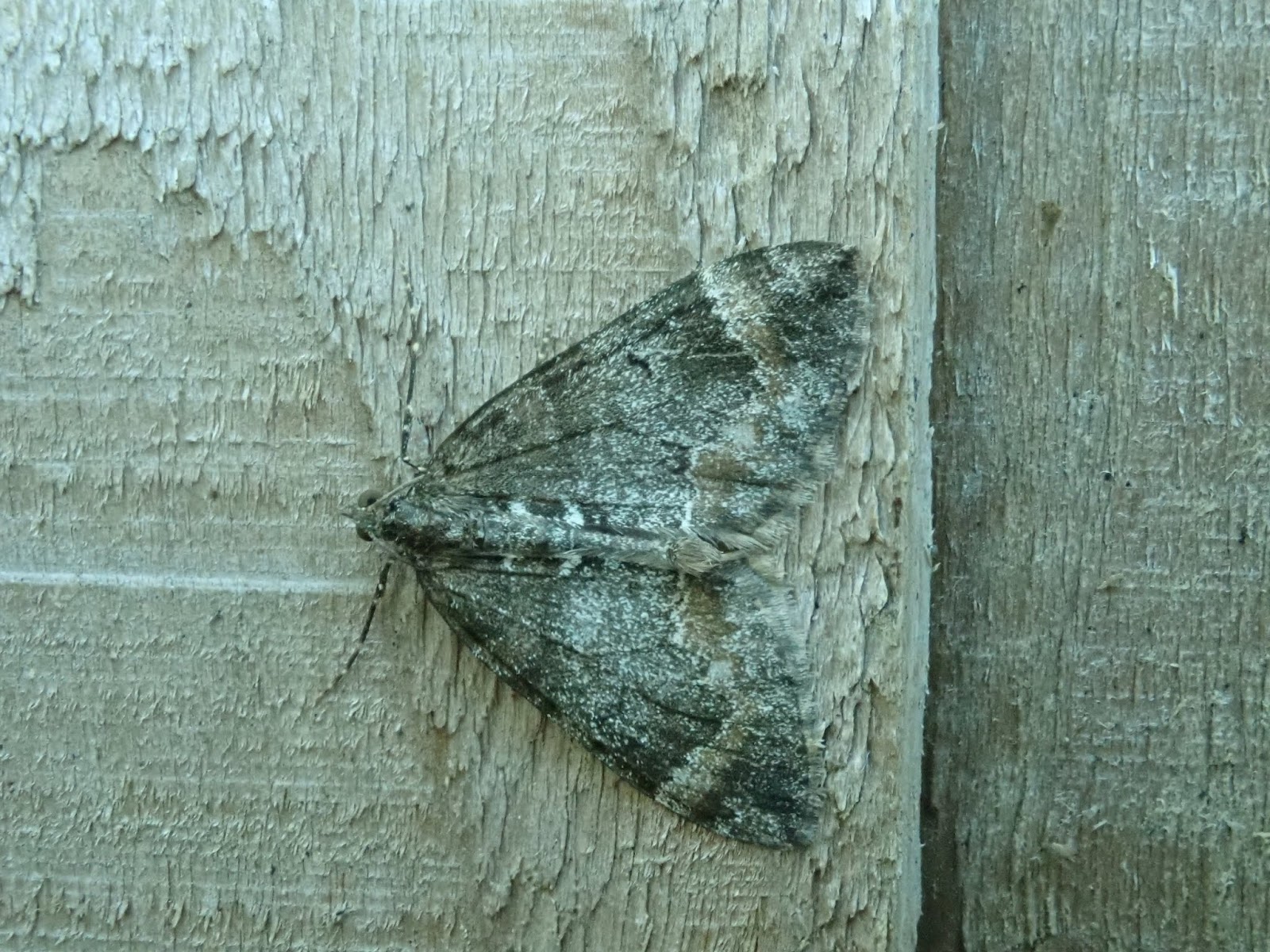
Put the trap out last night with a new, slightly larger box. Unfortunately, it didn't bring in more moths, with just 8 individuals from 7 species. Top performer was Peppered Moth with 2, Heart and Dart kept its sequence as the only species I've caught in every session (but that is only 3!), but reduced to just a single. 2 new for the garden were Flame Shoulder, Ochropleura plectra and Treble Lines Charanyca trigrammica. A rather dark pug on the exterior wall is proving difficult to nail, but suspect it's another Grey Pug, Eupithecia subfuscata.
                                        Flame Shoulder Ochropleura plectra
                                          Treble Lines Charanyca trigrammica
                                                    Grey Pug, Eupithecia subfuscata


Monday, 1 June 2020

The mothing gathers pace

Whilst most were moth trapping on Friday or Saturday night, I put my trapping off to last night and was rewarded with my best every catch - OK it's only the third catch, but it was a lot better than the previous two. A whopping 14 moths of no less than 10 species. And for the first time I didn't immediately recognise all the moths.

Some were easy and had already graced the trap previously - Poplar Hawkmoth, Buff-tip and a further 3 Heart and Dart. 2 Small Magpie were new for the trap but easy to recognise. A Lobster Moth took a couple of minutes for me to recognise as I think I've only ever seen one previously, back in 201, as did a Buff Ermine.

One on the outside of the trap had me immediately think The Coronet but looking at the guide, I doubted that and the more I looked the more I doubted that initial id. Fortunately, downloading the photo's and checking with the excellent UK Moths website brought me back to my original, initial id. The few nights I've gone out mothing with Mark Evans look to be paying off, and that I have remembered somethings.

Probably toughest was my first pug in the trap, but I think I'm OK with Grey Pug.
                                          Grey Pug, Eupithecia subfuscata (natural light)
                                          The same Grey Pug but under flash.

No beetles in the by-catch this time, but a lesser water boatman spp has been potted for a closer look later.

And a birding note to finish, as I was packing up there was a male Greenfinch singing nearby. He's been around all spring but I'm not sure if he has a mate. I hope he does as, like most places, the Greenfiches round here were badly hit by disease.

Wednesday, 27 May 2020

Improving, if only just.

I ran the moth trap out for its second run out last night. A slight increase in both species and numbers, 7 spp, and 10 in total. Nothing as spectacular as the Poplar Hawkmoth. Pale Tussock Calliteara pudibunda was the only species to show more than once - 2 males and a female.

The first micro turned up in the trap - a Light Brown Apple Moth, Epiphyas postvittana. Hardly surprising as its a species that turns up at the kitchen window most years, and I've already seen several whilst out and about.

Common Marbled Carpet, Chlorocysta truncata, Brown Silver-line, Petrophora chlorosata, Heart and Dart, Agroti exclamationis, Peppered Moth, Biston betulria and Satin Grass-veneer Crambus perlella made up the rest of the catch.

The bye-catch included several Caddisflies and a Black Sexton Beetle, Nicrophorus humator. Unlike the one last week, this one came complete with a load of mites, Poecilochirus spp. Looking into these mights, there is a suggestions from a 2017 paper that each species of might favours a singe species of Sexton Beetle. Unfortunately I couldn't get info on the species favouring N. humator.

On the wall was a small Soldier Beetle that turned out to be Rhagonycha lignosa, a lifer.


                                              Pale Tussock
                                           Common Marbled Carpet

                                          One of the smarter Caddisflies Athripsodes bilineatus

                                           Rhagonycha lignosa

Wednesday, 20 May 2020

Is it Christmas?

It had to happen, particularly as I got more and more into my pan-species listing, and I fought temptation for a long time but eventually surrendered and have gone over to the dark side and now own my own moth trap. A 20w blacklight Skinner type, currently this runs of mains, but hope to convert to run with a 5w blacklight LEDs that can be powered by my charger pack, making it more portable.

Last night was my first night of running the trap in the back yard, so it was a bit like Christmas this morning. I was up first thing to switch of the trap, had breakfast and then proceeded to inspect the nights catch (and preying there was a catch).

On the bathroom window, a Cinnabar was resting. Oh, looking promising. I lifted the first flap and there, in all it's glory was a Buff-tip. Result. A common enough species, but a nice species to go down as the first species recorded in the trap. Lifting the other flap, a Poplar Hawkmoth. Again common enough, but always nice to see.

After that, not much else, 3 Heart and Dart was the remainder of the catch.

A check of the back wall, did produce a 5th species, a Peppered Moth.

The byecatch included a single Cockchafer and a single Sexton Beetle (still to determine to species).

So not a lot caught but, I'm happy for now with the results, and hopefully better nights to follow over the next few years.


Tuesday, 31 March 2020

Anti-social-distancing

For some, social distancing and self-isolation comes quire naturally, myself included. Spending a day out and about in the countryside without seeing or speaking to anyone is a picture of nirvana. Unfortunately, the current lockdown means that a full day out and about away from all and sundry is a big NONO. So its a short walk for exercise and the back yard that has to provide the relief.

Most pg may daily walks is along Tram Road Side between Quakers Yard and Abercynon - it's my daily commute to Abercynon station, so I'm well used to walking it and know the bird life reasonable well. During this period of working from home, I'm walking the route at different times of the day to see how I get on recording different species.

On the avian front, the Chiffchaffs and Blackcaps have returned, although still only in low numbers, and quite worryingly I've not heard a Blackcap at, what has been, the primary site/territory along the trail - in previous years this was always the first territory occupied.

Insect and plant life is beginning to burst into life, From today's walk in quite pleasant sunshine, at least 3 Dark-edged Bee-fly's were on the wing and my first Tree Bumble Bee.  

 I did have a nice couple of finds today with an Engailed, Ectropis bistortata (I'm ready to be corrected) resting on a tree trunk. and the first Slow Worm of the year.


Sunday, 8 March 2020

The long walk.....

After a few trips where we seemed to maintain the quality of birding throughout the day, today we returned to a more normal service where the day starts well but gets quieter as the day progresses.

It was an early start - nothing new there - for myself, Phil and Martin Bevan, picking Martin up at 6am, as we headed down the Gower for the day. Whiteford, and the long walk round the point was first up, though we new Phil was going to struggle from the off, when he missed the car park entrance at Cwm Ivy.

A slow walk down through Cwm Ivy and the first block of conifers was rewarded when I pulled out my 5th Firecrest of the year.A series of heavy showers saw us take shelter in the hide, for the first coffee of the day. Martin decided the waterproof over trousers were in order so on the went before we resumed the walk out to the point and back. Walking out we had double figures of Snipe and 3 - 5 Jack Snipe, but otherwise there was little life to grab our attention until we reached the Lougher mouth, with the exception of a lone Whooper Swan flying over. Most of the wintering Brent Geese were feeding on the exposed shore, a few Red-breasted Mergansers and Great Crested Grebe, hunted the river channels, with masses of, predominantly, Herring Gulls. Oyk's, Curlew, Grey Plover and Turnstones were the waders of note, though Phil and Martin found a couple of Ringed Plover.

I found, and quickly lost a Slav Grebe, and then a Long-tailed Duck, appeared and disappeared just as quickly. I eventually managed to get both Phil and Martin onto the Long-tailed Duck, bore we found a second one. The Slav also eventually gave itself up - though it was rarely surfacing for any time.

The Eider were eventually picked up near the old lighthouse and a single Great Northern Diver and Common Scoter were also located. Martin also found a washed up Cuttlefish. Normally all we find are Cuttlefish "bones" but this was the entire animal - about 450mm in length, so quite a big animal. The upper side showing a nice herringbone pattern.


From Whiteford, we crossed the Gower to try for Dartford Warbs -a species which has become a bit of a nemesis for us all in the past few years. Suffice to say now sign of any Dartfords - though the wind was probably the main cause of that. Slight compensation in a couple of Chough and a female Black Oil Beetle Meloe proscarbaeus.
Back across to the north side of the Gower and Llanrhidian, where a couple of Great White Egrets were the stand out, along with some 800+ Golden Plover near Coity.


I then took the pair out to Salthouse Point - a site tick for both Phil and Martin - were we managed to find a distant Spoonbill on the Carmarthenshire shoreline.